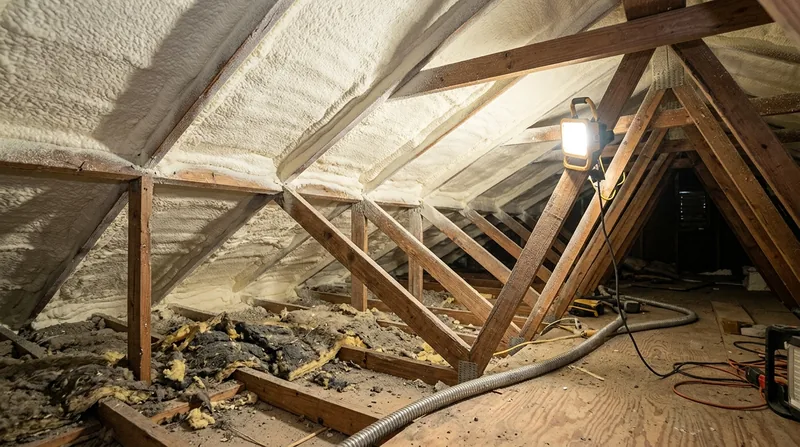




Insulation Replacement & Re-Insulation in West Palm Beach is the precondition of every retrofit job we perform. West Palm Beach's housing stock splits between 1920s wood-frame bungalows in Northwood and El Cid, postwar concrete block homes throughout Lake Worth Beach and the core, and newer slab-on-grade townhomes in Wellington and Royal Palm Beach, all of them routing ductwork and air handlers through vented attics where the real cooling loss happens. Attics here lose insulation value fast under constant heat and humidity. After we strip out the old material, we spray foam directly under the roof deck or re-insulate vented attics so Palm Beach County homes hold the line on cooling bills. The difference between a sound attic and a failed one is the difference between a $180 and a $320 monthly cooling bill. We remove the old insulation, seal the air leaks, and install spray foam or blown-in material that actually stays effective year after year in this climate.
Why Insulation Replacement Matters in West Palm Beach's Hot, Humid Climate
West Palm Beach sits in IECC climate zone 2A, hot and humid nearly year-round, with daily storms in the wet season and hurricane season from June through November. Vapor drive runs from outside toward the inside whenever the outdoor air is hotter and wetter than the conditioned interior, which is almost always. Old fiberglass batts, blown-in cellulose, and failed spray foam degrade under this constant moisture load. Settling, compression, and moisture absorption rob the R-value you paid for, and the air leaks around the edges of the old material let conditioned air escape into the attic before it reaches the vents.
- Old insulation compresses and settles, losing R-value and leaving gaps that leak air directly into the attic.
- Moisture penetration degrades fiberglass and cellulose faster in humid climates, especially in vented attics where outdoor air enters continuously.
- Ductwork sitting in a hot attic bleeds cool air before it reaches the rooms, wasting 15 to 25 percent of your cooling output.
- Air leaks around electrical penetrations, HVAC boots, and the attic hatch account for 20 to 30 percent of total air loss in most West Palm Beach homes.
- Replacing old material with spray foam under the roof deck or sealing a vented attic stops vapor drive and air leakage in one pass.
These are the failure modes that actually drive cooling bills in this market, and insulation replacement is the only way to address them permanently.
Key info: A Lake Worth Beach home with 1970s fiberglass batts and a vented attic typically runs 20 to 35 percent higher cooling costs than an identical home with a sealed attic and closed-cell foam. That gap widens every year as the old material continues to fail.
For more details on sealing the attic boundary, see our attic spray foam insulation page.
How Insulation Replacement Works: Our Process in West Palm Beach
We start with a full walkthrough of the attic or wall cavity to assess what is there, how much, and what condition it is in. We measure the R-value and thickness of the existing material, check for moisture damage, rodent contamination, or settled material. We photograph the substrate and identify any air leaks, missing sections, or thermal barriers. We then give you a written estimate with the R-value and thickness of the new foam, the board feet required, and the labor and material cost.
- We remove all old insulation, blown-in or batts, and haul it off the property.
- We air-seal the attic boundary with spray foam around electrical penetrations, HVAC boots, ductwork, the attic hatch, and the band joist.
- We spray closed-cell or open-cell foam to the specified R-value and thickness, measured on site at the board foot.
- We maintain mechanical ventilation during cure and observe a re-entry window of 24 to 48 hours before occupancy resumes.
- We provide a written receipt with the R-value, thickness, and board feet installed, plus the warranty and re-entry timeline.
The entire job, from removal through final spray, typically takes one to three days depending on attic size and access.
Example: A 1,200-square-foot vented attic in Royal Palm Beach with blown-in cellulose at R-19 and significant settling required removal, air-sealing of all penetrations, and 4 inches of closed-cell foam (R-28 to R-32) to restore the thermal boundary and stop the air leaks. The job took two days, and the homeowner saw a 22 percent drop in cooling costs within the first month.
For details on how we handle air sealing alongside foam installation, see our air sealing page.
Insulation Replacement Methods: Spray Foam vs. Blown-In
| Approach | Description | Best for |
|---|---|---|
| Closed-Cell Spray Foam | High-density foam applied at 1.5 to 2 pounds per cubic foot, R-6 to R-7 per inch, forms a rigid air barrier and vapor barrier in one pass. | Sealed roof decks, vented attics with ductwork, moisture-prone areas, metal buildings, and West Palm Beach homes where vapor drive is the dominant failure mode. |
| Open-Cell Spray Foam | Lower-density foam applied at 0.4 to 0.6 pounds per cubic foot, R-3.5 to R-3.8 per inch, acts as an air barrier but not a vapor barrier, allows drying to interior. | Vented attics above living space where sound dampening is desired and the attic can dry to the interior, and budget-conscious retrofits where R-19 to R-30 is the target. |
| Blown-In Cellulose or Fiberglass | Loose-fill material blown to R-30 to R-60 depending on density and depth, no air barrier, settles over time. | Top-up of a sound attic where the substrate is clean, no air leaks are present, and the homeowner's priority is R-value at the lowest cost. |
| Injection Foam in Walls | Low-pressure foam injected into closed wall cavities without demolition, fills voids and creates an air barrier within the existing wall. | Pre-1980 concrete block or wood-frame homes in West Palm Beach where the wall cavity is empty or contains failed insulation and the exterior is not being opened. |
The choice depends on your attic type, the failure mode you are addressing, and your cooling bill priority. On a simple top-up of a sound attic with no air leaks, blown-in is sometimes the right answer and we say so plainly. On a vented attic with ductwork and significant air leaks, closed-cell foam is the only fix that stops both vapor drive and air loss.
Insulation Replacement & Re-Insulation Cost in West Palm Beach: What to Expect
Cost depends on the size of the attic, the type of old material, the density of air leaks, and whether you choose spray foam or blown-in replacement. A typical vented attic insulation removal and re-spray in West Palm Beach runs from $2,800 to $6,500. The price factors in labor to remove the old material, haul-off, air-sealing of penetrations, and the foam or blown-in material itself, measured at the board foot on site. Attics with significant air leaks, ductwork that needs sealing, or a sealed roof deck requirement cost more. Attics that are already reasonably clean and just need a top-up with blown-in material cost less.
- A 1,000 to 1,500 square foot vented attic with partial old material and moderate air leaks typically costs $3,200 to $4,800 for closed-cell foam replacement.
- A 1,500 to 2,000 square foot attic with significant settling, ductwork sealing, and full removal costs $4,500 to $6,500.
- A simple blown-in top-up on a clean, sound attic costs $1,800 to $3,000.
- Sealed roof deck conversion, which requires thicker foam and more labor, costs $5,500 to $8,000 for a typical West Palm Beach home.
Get 2 to 3 written estimates with R-value and thickness specs before you book. The estimate is free, and we respond within 24 hours. See our full pricing page for more detail on what drives these figures.
Insulation Replacement & Re-Insulation Near Me: What West Palm Beach Homeowners Should Know Before Hiring
The spray foam trade has two kinds of operators: rig-and-run crews from out of state who spray a job in an afternoon and are unreachable when the smell will not go away, and national franchises that subcontract to local crews with no accountability. The local independent is positioned against both. Honest guidance is the differentiator. When you are evaluating a spray foam contractor, verify their insurance coverage by asking for a certificate of insurance naming you as additional insured. Ask for references and call them. Request a written estimate that includes the R-value, thickness, and board feet of foam, not just a dollar amount. Understand what permits apply at your address by calling your local building department, and verify that the contractor knows the code requirements in your city, not just one generic set of rules.
- Get a written estimate with R-value and thickness specs, never just a per-square-foot or per-board-foot price with no measurement.
- Ask the contractor to name the local building official and the code in force at your address, and defer to that official on thermal barriers, ignition barriers, and attic ventilation.
- Verify insurance by requesting a certificate of insurance, and confirm that the contractor will be on site during the job, not a subcontractor you have never met.
- Ask about mechanical ventilation during cure and the re-entry window, and confirm that the job will not be occupied for 24 to 48 hours after the spray is complete.
- Check references from at least two recent jobs in your neighborhood, and ask about smell, timeline, and whether the contractor was reachable if questions came up after the job.
Call us at (561) 621-4973 to schedule a free estimate, or visit our contact page to request one online. We have been in business since 2012 and provide written estimates with R-value and thickness specs on every job.
Insulation Replacement & Re-Insulation in West Palm Beach: Pricing Guide
| Service | Price | Details |
|---|---|---|
| Blown-in top-up on sound attic | Starting at $1,800 | Removal of old material, cleanup, and blown-in cellulose or fiberglass to R-30 to R-38, sized to your attic square footage |
| Vented attic with spray foam and air sealing | Starting at $2,800 | Removal of old insulation, air-sealing of penetrations and HVAC boots, and closed-cell or open-cell foam to R-28 to R-32, typical 1,200 to 1,500 sq ft |
| Large or complex attic with sealed roof deck | Starting at $5,500 | Full removal, ductwork sealing, and closed-cell foam sprayed to the underside of the roof deck for maximum thermal control and vapor barrier |
| Injection foam in wall cavities | Starting at $1,200 | Low-pressure foam injected into closed wall cavities without demolition, priced per linear foot of wall cavity and measured on site |
| Travel and estimates | Included | No separate charge for travel within West Palm Beach and surrounding service areas, free written estimate within 24 hours |
Indicative pricing, the exact cost depends on square footage, finish, and site access. Free personalized estimate within 24h at (561) 621-4973.


