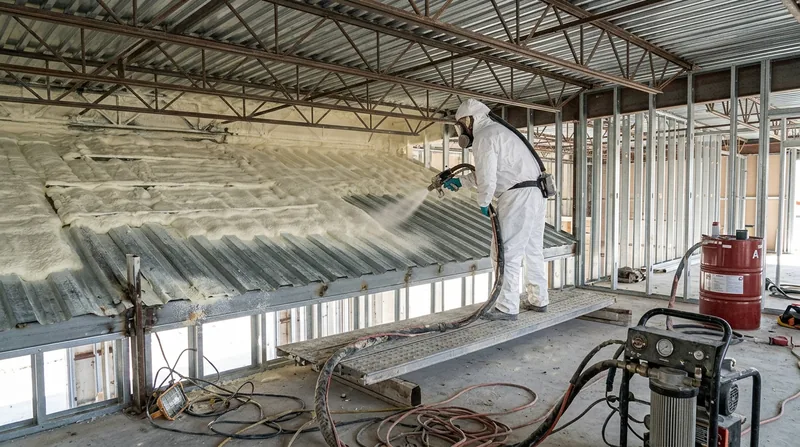




Commercial & New Construction Spray Foam in West Palm Beach protects small commercial buildings and new construction from the same relentless heat and humidity that drives residential cooling bills across Palm Beach County. West Palm Beach's commercial landscape splits between older concrete block structures in the city core, newer slab-on-grade construction west toward Wellington and Greenacres, and scattered retrofit opportunities in Lake Worth Beach, Boynton Beach, and Delray Beach. In IECC climate zone 2A, outdoor air is nearly always hotter and wetter than the air-conditioned interior, so vapor drive pushes moisture into wall cavities and roof decks wherever the air barrier breaks. Cooling loads in small commercial buildings mirror those in homes: uninsulated or poorly insulated roof decks and exterior walls bleed conditioned air and allow radiant heat to penetrate the envelope. Spray foam seals both the air barrier and the thermal boundary in a single pass, cutting ductwork losses and reducing the load on the compressor before the next cooling season starts.
Why Commercial & New Construction Spray Foam Matters in West Palm Beach
Small commercial buildings across West Palm Beach face cooling costs that climb with every degree of outdoor heat. Most existing commercial structures were built with fiberglass batts or blown-in insulation in the attic and little to no air sealing, leaving gaps at the rim, uninsulated walls, and ductwork running through unconditioned space. New construction offers the chance to get the envelope right from the start, but only if the builder and insulation contractor coordinate before drywall goes up. Spray foam on roof decks and in wall cavities before closure creates a continuous air barrier and thermal break that fiberglass cannot match.
- Seal roof decks and walls in a single application, eliminating the multi-step process of tape, caulk, and board.
- Create a vapor barrier on the warm side of the envelope, stopping humid outdoor air from condensing in cavities and on metal roof decks.
- Reduce ductwork losses by insulating and sealing the air handler closet or mechanical room before ductwork is run.
- Meet or exceed local energy code requirements for new construction without oversizing the HVAC system.
- Protect metal roof decks and steel-frame buildings from condensation damage that ruins insulation and corrodes fasteners.
Getting the air barrier and thermal envelope right before occupancy avoids costly retrofits and keeps cooling bills predictable for the life of the building.
Key info: A small retail space in Lake Worth Beach with an uninsulated flat roof and a single-zone air handler can waste 30 to 40 percent of its cooling capacity through the ceiling and ductwork. Spray foam on the roof deck and around the handler closet cuts that loss in half and pays for itself in three to five years of lower electric bills.
The Florida Building Code and local building departments across West Palm Beach, Royal Palm Beach, Wellington, and Boynton Beach govern thermal barriers, ignition barriers, and ventilation requirements for spray foam in commercial buildings. Verify what applies at your address and permit status with your local building official before scheduling work. For guidance on commercial insulation codes in Florida, consult the Palm Beach County government website or your city's building department directly.
How We Spray Foam Commercial Buildings and New Construction in West Palm Beach
Commercial spray foam work follows the same core steps as residential attic insulation, but with stricter coordination on schedule and a focus on sealing before drywall, doors, and mechanical equipment go in. We work with builders, contractors, and property owners to spray roof decks, wall cavities, rim joists, and mechanical closets on a timeline that fits the construction sequence. On retrofit jobs, we assess the existing envelope, remove failed or inadequate insulation if needed, seal air leaks, and spray new foam to code-compliant thickness and density.
- Schedule the spray work after framing and rough-in, before drywall, roofing, or mechanical closure.
- Inspect the substrate for moisture, holes, or contamination that would prevent proper foam adhesion and cure.
- Set up mechanical ventilation and establish a re-entry window of twenty-four to forty-eight hours post-spray.
- Spray foam to the specified R-value and thickness, documented in writing with board-foot volume and coverage photos.
- Verify that thermal barriers, ignition barriers, and any required ventilation meet local code before the building is closed.
- Provide the builder or owner with a workmanship warranty and technical documentation for the insulation system.
Coordination and documentation are what separate a spray foam job that protects the building from one that creates liability and warranty disputes. We document every job with written estimates that specify R-value, thickness, and board feet before we spray, and we walk away from any substrate that is wet, contaminated, or has active leaks.
Example: A new professional office building in Palm Beach Gardens scheduled spray foam for the roof deck and wall cavities two weeks after framing was complete. We coordinated with the general contractor to ensure the roof was weather-tight and dry, set up mechanical ventilation during the spray window, and provided the builder with a detailed specification sheet showing R-value, thickness, and thermal barrier certification before drywall started. The building stayed on schedule and the owner cut HVAC sizing by one ton because the envelope was sealed from the start.
Our approach to commercial and new construction work is the same as our approach to attic spray foam insulation: correct installation, transparent documentation, and a willingness to defer to the local building official on what code requires at your address.
Commercial & New Construction Spray Foam Methods and Approaches
| Approach | Description | Best for |
|---|---|---|
| Closed Cell Spray Foam | High-density foam (3.5 to 4.5 lbs/cf) with an R-value of 6 to 7 per inch. Creates a vapor barrier and provides structural rigidity. | Metal roof decks, unvented attics, and walls where condensation control is critical. Typical thickness 2 to 4 inches for R-12 to R-28. |
| Open Cell Spray Foam | Low-density foam (0.5 to 1.5 lbs/cf) with an R-value of 3.5 to 4 per inch. Allows vapor diffusion and is lighter weight. | Interior wall cavities and attics in climate-controlled buildings where cost is a factor and vapor control is managed by other means. |
| Injection Foam Retrofit | Low-pressure foam injected into existing wall cavities through small holes, sealing without demolition. Typically closed cell for vapor control. | Existing concrete block or wood-frame walls in retrofit work, where removing drywall is not an option. Common in older commercial buildings across West Palm Beach and Lake Worth Beach. |
| Insulation Removal and Replacement | We remove failed fiberglass, cellulose, or old foam and replace it with new spray foam, sealing air leaks in the process. | Commercial buildings with wet, damaged, or inadequate insulation. Precondition for any retrofit that must meet current code. |
Closed cell is the standard for commercial roof decks and metal buildings in Florida because it controls vapor and provides the structural integrity needed on unvented decks. Open cell is used less often in commercial work but can be appropriate in climate-controlled interiors where cost matters and the vapor drive is managed by the air conditioning system. Injection foam is the retrofit workhorse for existing concrete block and wood-frame walls in older commercial stock.
Commercial & New Construction Spray Foam Cost in West Palm Beach: What to Expect
Commercial spray foam pricing depends on roof deck area, wall cavity volume, foam type (closed or open cell), accessibility, and the condition of the existing structure. A small retrofit of 2,000 to 3,000 board feet of closed cell foam on a flat roof deck typically runs higher per board foot than a large new construction project of 10,000 board feet, because labor and equipment setup are spread across fewer square feet. New construction jobs are generally more efficient because the substrate is clean, dry, and accessible before closure, while retrofit work may require insulation removal, air sealing, and moisture remediation first.
We provide a free commercial estimate that documents the square footage, substrate condition, foam type, specified R-value and thickness, estimated board feet, and a realistic price range. The estimate includes a site visit, photos, and a written specification. Most small commercial roof decks and wall retrofits in West Palm Beach, Delray Beach, and Boynton Beach run from $1,500 to $8,000 depending on area and foam type. New construction jobs are priced per board foot and documented in the contract before work starts. For detailed pricing on your specific project, contact us at (561) 621-4973 or request a free estimate through our pricing page.
Factors that move the price up include insulation removal (if old foam or fiberglass must come out first), air sealing and caulking around penetrations and rim joists, moisture remediation (we fix the moisture first or we walk away), and thickness above code minimum. Travel is included in West Palm Beach and surrounding areas, no separate mileage fee. Getting 2 to 3 estimates from contractors who specify R-value, thickness, and board feet in writing is the best way to compare apples to apples and avoid low-ball bids that cut corners on density, thickness, or ventilation during cure.
Spray foam is a long-term investment in the building envelope. A properly installed commercial roof deck spray foam system will last 30+ years with no degradation if the substrate stays dry and the foam is not exposed to UV or mechanical damage. Closed cell spray foam on a metal roof deck in a hot, humid climate like West Palm Beach pays for itself through reduced cooling costs and eliminates the need for vapor barriers, underlayment, and mechanical ventilation that would otherwise be required.
What to Look for When Hiring a Commercial Spray Foam Contractor Near West Palm Beach
Spray foam is a specialized trade, and the difference between a careful installer and a careless one shows up in comfort, energy bills, and building durability. When you are evaluating spray foam contractors near West Palm Beach, Riviera Beach, Wellington, or any other city in Palm Beach County, look for evidence of correct technique, transparency on pricing and specifications, and willingness to work with your builder or building official on permits and code compliance.
- Ask for a written estimate that specifies R-value, foam thickness in inches, estimated board feet, and the type of foam (closed or open cell).
- Verify that the contractor is fully insured and can provide a certificate of insurance naming your building as an additional insured.
- Check references from recent commercial projects in West Palm Beach or nearby cities, and ask about the contractor's experience with your building type.
- Confirm that the contractor will set up mechanical ventilation during the spray and cure window, and specify a re-entry time of twenty-four to forty-eight hours.
- Ask whether the contractor has worked with your local building department and can explain what permits and thermal barrier requirements apply at your address.
- Avoid any estimate that omits R-value, thickness, or board feet, or that promises immediate re-entry, or that is far below market price with no inspection or documentation.
A local contractor with a track record in West Palm Beach, Royal Palm Beach, Lake Worth Beach, and Boynton Beach knows the building stock, the building officials, and the climate challenges that drive the work. We have been in business since 2012 and we provide written estimates with R-value and thickness specs, fully insured coverage, and a willingness to walk away from any job where the substrate is wet or the scope is not clear. Contact us at (561) 621-4973 or visit our contact page for a free, no-obligation estimate on your commercial building or new construction project.
Commercial & New Construction Spray Foam in West Palm Beach: Pricing Guide
| Service | Price | Details |
|---|---|---|
| Free commercial estimate | Free | Site visit, photos, written spec with R-value, thickness, and board feet estimate, no obligation to book |
| Small commercial roof or wall retrofit | Starting at $1,500 | 2,000 to 3,000 board feet closed cell foam on flat roof or wall cavities, includes air sealing and substrate inspection |
| Medium new construction or retrofit | Starting at $3,500 | 5,000 to 7,000 board feet, includes coordination with builder, mechanical ventilation setup, and thermal barrier certification |
| Large commercial or metal building project | On estimate | 10,000+ board feet, multiple roof sections, or complex air sealing requires on-site assessment and builder coordination before pricing |
| Insulation removal and replacement | On estimate | Cost depends on volume of old material, disposal method, substrate condition, and new foam type and thickness required |
| Travel | Included | No mileage or travel fee in West Palm Beach and surrounding Palm Beach County service areas |
Indicative pricing, the exact cost depends on square footage, finish, and site access. Free personalized estimate within 24h at (561) 621-4973.


