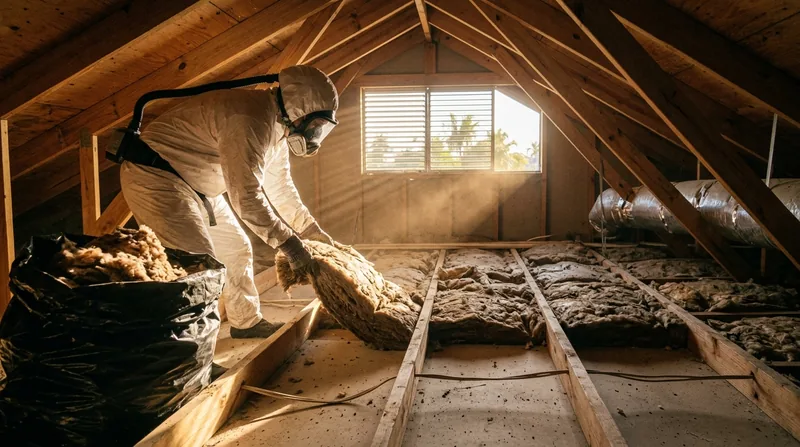




Insulation Removal in West Palm Beach is the critical first step before any retrofit or replacement job. Old batts, blown-in fiberglass, and failed foam in vented attics across Palm Beach County absorb humidity from the hot, wet air that drives into those spaces year-round, losing R-value fast and trapping moisture that feeds mold and decay in the framing below. West Palm Beach's mix of 1920s bungalows in Northwood and El Cid, postwar concrete block homes throughout Lake Worth Beach and the core, and newer slab-on-grade construction in Wellington and Royal Palm Beach all route their ductwork and air handlers through vented attics instead of conditioned space, which means the insulation above that ceiling is working against outdoor air that is almost always hotter and wetter than the cooled interior. When that insulation fails, cooling bills climb and the structure itself starts to suffer. We clear out deteriorated or wet insulation from attics across Palm Beach County, prep the space clean, and get it ready for new attic spray foam insulation or fiber fill. The job is straightforward, the payoff is immediate, and getting it right is the foundation of any lasting retrofit.
Why Old Insulation Fails Fast in West Palm Beach's Heat and Humidity
Palm Beach County sits in IECC climate zone 2A, hot and humid nearly year-round, with daily thunderstorms in the wet season and hurricane season from June through November. That outdoor air is almost always warmer and wetter than the air-conditioned interior, so vapor drive runs from outside toward inside, working into attics and wall cavities wherever the air barrier breaks. Fiberglass batts and blown-in cellulose absorb that moisture, compress under their own weight, and stop performing long before their theoretical R-value lifespan. Vented attics in homes across Riviera Beach, Palm Beach Gardens, and Boynton Beach see this failure mode constantly: the insulation looks intact from the hatch, but the density is gone, the moisture content is high, and the thermal resistance has collapsed.
- Moisture absorption in fiberglass and cellulose reduces R-value by 20 to 40 percent before visible mold appears.
- Settled or compressed batts create air pockets and thermal bridges that bleed conditioned air and let heat radiate straight down through the ceiling.
- Wet insulation in an attic above a slab-on-grade home spreads moisture into the framing and rim joist, feeding wood rot and attracting insects.
- Failed insulation in a vented attic over a concrete block home compounds the heat load on the block walls themselves, raising cooling demand across the entire house.
Removing that failed insulation and starting fresh is the only path to a sound, efficient attic.
Key info: In West Palm Beach's Northwood and El Cid neighborhoods, homes built before 1960 often have original fiberglass batts or loose fill that have never been replaced. In newer slab-on-grade subdivisions like Wellington and Royal Palm Beach, blown-in fiberglass installed in the 1990s and 2000s frequently fails by year 20 to 25 due to moisture and settling. A visual inspection from the attic hatch usually shows the problem: dark staining, clumping, or a musty smell is a signal that removal and replacement is overdue.
How We Remove Insulation and Prep Your Attic in West Palm Beach
Insulation removal is a physical, dusty job that requires containment, ventilation, and care to avoid spreading debris and fibers into the living space below. We set up negative air pressure in the attic, use HEPA filtration and sealed equipment, clear out all old material by hand or vacuum, inspect the framing and substrate for damage or moisture, and leave the space clean and ready for new insulation or air sealing. The process takes one to two days depending on attic size, access, and the condition of what we find underneath.
- We isolate the attic work area from the living space with plastic barriers and seal all penetrations to prevent fiber or dust from entering the home.
- We run mechanical ventilation and HEPA filtration during the entire removal to capture airborne particles and protect both the crew and the house.
- We remove all old insulation by hand or low-speed vacuum, taking care not to disturb vermiculite or other materials flagged for testing by a licensed professional.
- We inspect the substrate, framing, ductwork, and roof decking for moisture, mold, damage, or pest activity and document what we find.
- We sweep and vacuum the attic clean, remove all debris from the site, and leave the space ready for new insulation or foam application.
A clean, prepped attic is the only foundation for a successful retrofit that will last.
Real example: A concrete block home in Lake Worth Beach had blown-in fiberglass installed in 1998. By 2024, the insulation had settled to half its original thickness and absorbed enough moisture to feel damp to the touch. We removed it all, found the roof decking was sound but the rim joist framing showed light mold, cleaned the attic thoroughly, and the homeowner replaced the rim joist with spray foam rim joist insulation and new attic foam. The cooling bill dropped 22 percent in the first summer.
Insulation Removal Methods and When to Use Each
| Approach | Description | Best For |
|---|---|---|
| Hand removal and bagging | Batts or loose fill pulled out by hand, placed in heavy plastic bags, sealed, and removed from the site with full containment and dust control. | Attics with limited access, homes with known asbestos or vermiculite, or jobs where minimal dust generation is critical to protect HVAC equipment or living space. |
| Low-speed vacuum removal | Blown-in or settled fiberglass suctioned into a sealed collection tank with HEPA filtration, containment, and mechanical ventilation running throughout. | Large attics with deep blown-in insulation, homes in Boynton Beach and Delray Beach where speed and efficiency matter, and jobs where the substrate is sound and no hand inspection is needed. |
| Spray foam removal | Deteriorated or water-damaged closed cell or open cell foam cut out, bagged, and disposed of, with substrate inspection and prep for new insulation. | Attics with failed foam jobs, homes where prior spray foam work was done without proper ventilation or application, and any retrofit where the old foam is wet, contaminated, or thermally failed. |
| Substrate prep and sealing | After removal, we inspect, clean, and seal any gaps, cracks, or air leaks in the decking, framing, or rim joists before new insulation is installed. | All removal jobs in West Palm Beach, because attic air leaks are the real driver of cooling bills and must be addressed alongside insulation replacement. |
Insulation Removal Cost in West Palm Beach: What to Expect
Insulation removal in West Palm Beach typically starts at $950 for a small attic (under 500 square feet) with light fiberglass or blown-in material and good access from a central hatch. The cost rises with attic size, insulation depth and density, substrate condition, and the complexity of disposal. A large attic in a 1970s home in Wellington with 12 inches of settled blown-in fiberglass over ductwork and a compromised rim joist will run $1,500 to $2,200 depending on what we find once we start. Spray foam removal is higher because it requires careful cutting, bagging, and handling. Always get two or three estimates from contractors who will show up on site, measure the attic, and give you a written breakdown of labor, containment, ventilation, disposal, and substrate prep. A low estimate with no detail about how the job will be done is a red flag. See our pricing page for a full breakdown of what moves the estimate up or down.
Insulation Removal Near Me: What West Palm Beach Homeowners Should Know When Hiring a Contractor
Hiring the right contractor for insulation removal is about verifying three things: that the crew is fully insured and can provide proof of coverage, that the estimate includes a clear scope and R-value or depth spec for what's being removed, and that the contractor has a real address and local phone number you can reach if questions come up after the job. Ask for references from homes in your neighborhood (Northwood, El Cid, Lake Clarke Shores, Lake Worth Beach, and Wellington all have different housing stock and removal challenges), request a written estimate with itemized labor, containment, ventilation, and disposal costs, and verify that the contractor will inspect and document the substrate condition before you commit to new insulation. If your home is in an HOA or historic district, confirm that exterior work or dumpster placement meets local rules. Check the local building department website for your city to understand what permits or inspections apply to insulation work at your address. Call us at (561) 621-4973 for a free estimate, or visit our contact page to request one online. We measure every attic on site, provide a written estimate with R-value and thickness specs, and explain exactly what we'll do and why.
Insulation Removal in West Palm Beach: Pricing Guide
| Service | Price | Details |
|---|---|---|
| Small attic (under 500 sq ft) | Starting at $950 | Light fiberglass or blown-in material, good attic access, standard containment and disposal included |
| Medium attic (500 to 1,000 sq ft) | Starting at $1,300 | Moderate depth of settled insulation, typical West Palm Beach framing, mechanical ventilation and HEPA filtration |
| Large attic (over 1,000 sq ft) or spray foam removal | Starting at $1,800 | Deep blown-in material, spray foam cutting and bagging, complex substrate prep, or multiple access points |
| Substrate inspection and repair | Included with removal | Framing and decking assessment, documentation of moisture or damage, air sealing prep at no extra charge |
| Disposal and site cleanup | Included | All old insulation removed from site, debris bagged and hauled, attic swept clean, no extra fees |
| Free estimate | No obligation | On-site measure, written quote with breakdown, response within 24 hours at (561) 621-4973 |
Indicative pricing, the exact cost depends on square footage, finish, and site access. Free personalized estimate within 24h at (561) 621-4973.


